The Four Documents an Insurer Asks a Med Spa For First
Published September 22, 2026 · 5 minute read
The request usually arrives as a list. A new policy, a renewal, a claim, or a routine underwriting review, and the carrier wants to see how the practice is governed. The list varies by carrier and by line of coverage, and nothing here replaces the one your own carrier sends. But four items appear on nearly every version of it, and a practice that has them in a binder answers the letter in an afternoon. A practice that does not spends a month assembling them and learns what it never wrote down.
1. Written protocols, signed by the accountable prescriber
The first ask is almost always some form of "your written clinical protocols and standing orders." The reviewer is not reading them for clinical content. They are looking for three things: that protocols exist in writing for the services offered, that the clinical decisions in them were made by a named prescriber accountable for the practice, and that this person signed them.
That third point is where templates fail. A downloaded protocol with doses and thresholds already filled in by an unknown author is not a practice protocol. It is somebody else's document with your logo on it, and a reviewer can tell. What a reviewer wants to see is the reverse: a framework where the clinical fields were blank when it arrived and are now completed in your prescriber's hand, with their signature and license number on every page, not just the cover.
The emergency protocols are the ones read most carefully. A practice offering injectables is expected to have a written response for the complications those injectables can produce, and the escalation path for each.
2. The supervision and delegation structure
Who is allowed to do what, under whose authority, and how that authority is exercised. In practice this is a governance page: the accountable prescriber's name, title as used in the practice, license number, and how they are reached during treatment hours; what evaluation happens before a new patient is treated and who performs it; what standing orders or protocols delegate which procedures to which roles; and how supervision actually works day to day, on site or otherwise.
Every one of those is a jurisdictional question, and the answers differ across state lines. So the document a reviewer respects is not one that asserts what the rules are. It is one that shows the practice looked them up: a verification page listing each governance question, which authority was consulted, on what date, and who verified it. A dated verification trail says the practice takes the question seriously. An undated assertion says the opposite.
3. Intake, screening, and consent records
The third ask is patient-side: how the practice screens before treating, and how consent is documented. A reviewer wants to see that a health history is taken, that it is service-specific where it needs to be, that a prescriber evaluation is recorded before treatment, and that consent is documented for each service, not once at the first visit for everything thereafter.
The screening form does not need to contain clinical thresholds. In fact it should not, for the same reason the protocols should not: those are prescriber decisions. What it needs is to show the categories that were asked about, the fields where the prescriber recorded their evaluation, and a signature. A blank form with the right structure and a completed form with a prescriber's initials on it are both useful to a reviewer. A form that skips the evaluation field entirely is not.
4. Treatment records with lot traceability
The fourth is the one most practices cannot produce on request, and it is the one that matters most in a claim.
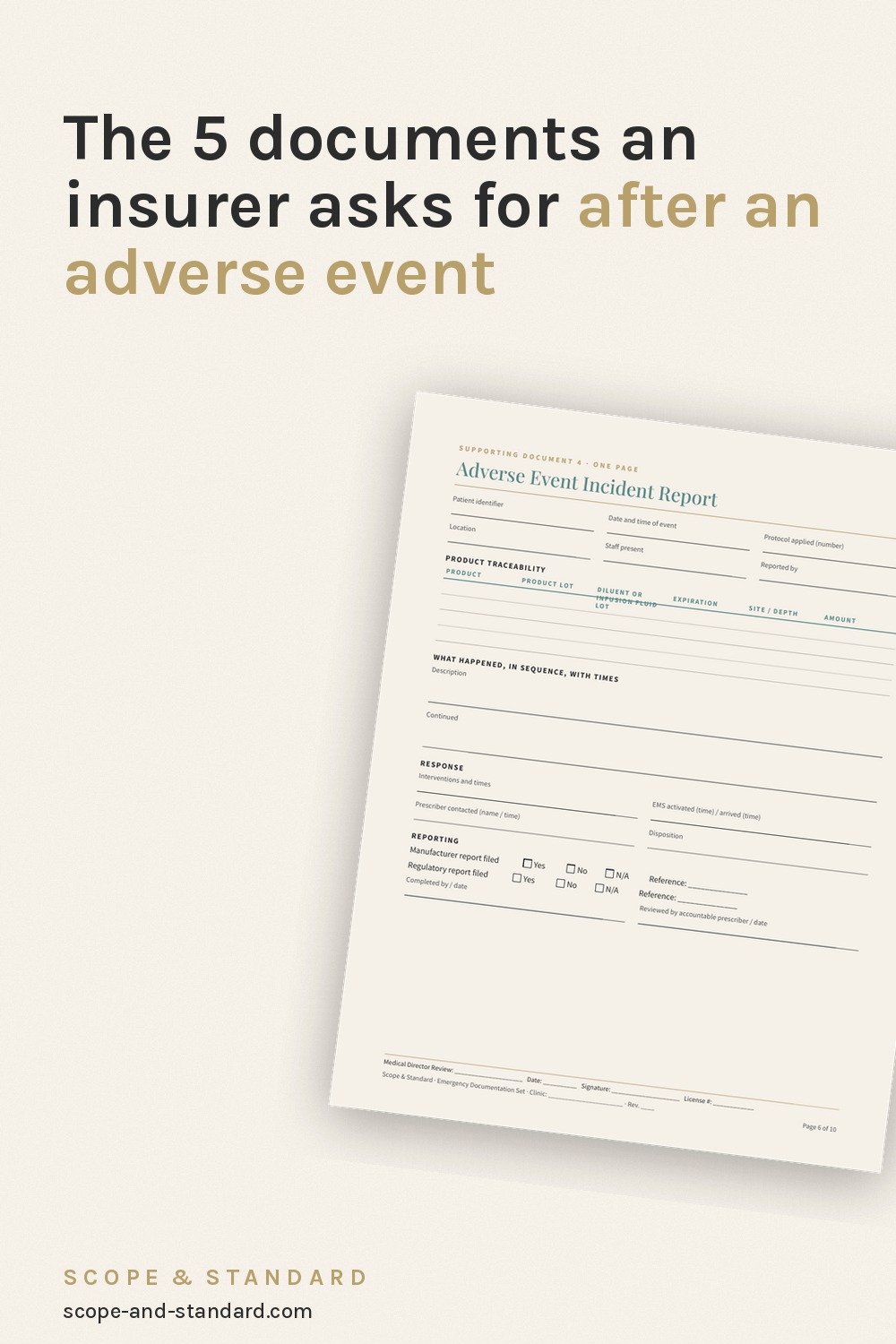
A per-encounter treatment record: what was done, where, by whom, with which product, from which lot, with what response, and what aftercare was given. For injectables that means product, lot, expiration, site, amount, and technique, with a site map. For infusions it means the order as written, the lot of every component and of the base fluid, the access details, a monitoring grid, and the discharge criteria met.
The lot fields are the part reviewers care about and practices skip. In a product recall, a practice with lot traceability can name every affected patient in minutes. A practice without it has to assume everyone in a date range and call them all. In an adverse event claim, the lot number is what separates a product question from a technique question. Recording it costs a few seconds per encounter. Not recording it can cost the claim.
What the four have in common
None of them contain clinical content written by anyone outside the practice. All of them are frameworks: the structure is fixed, the decisions inside the structure belong to the practice's own accountable prescriber, and every one carries that person's signature. That is the shape a reviewer trusts, because it shows a practice that knows where its own authority begins and ends.
And all four should exist before the letter arrives. The month it takes to assemble them under a deadline is a month a practice does not have during a claim.
The reviewer is not grading your medicine. They are checking whether the practice knows who decided, when, and whether it was written down.
- Complication Protocol Bundle, 18 protocols, $89
- Intake and Screening Module, $29
- Injectable Treatment Record, $8
- Emergency Documentation Set, $29
Questions this guide answers
What documentation does a med spa need for insurance?
Carriers and underwriters vary, and the only authoritative list is the one your own carrier gives you. The four that come up first in most requests are written protocols with a medical director sign-off, a documented supervision or delegation structure, patient intake and consent records, and per-encounter treatment records with product lot traceability.
Does a downloaded template count as a written protocol?
Only once your accountable prescriber has completed the clinical fields and signed it. An unsigned template with someone else's decisions in it is neither your protocol nor evidence of your governance.
What is lot traceability and why does an insurer care?
The ability to name, for any patient encounter, the product and lot number used, and for infusions the fluid lot as well. In a recall or an adverse event it is what lets a practice identify every affected patient in minutes rather than days.