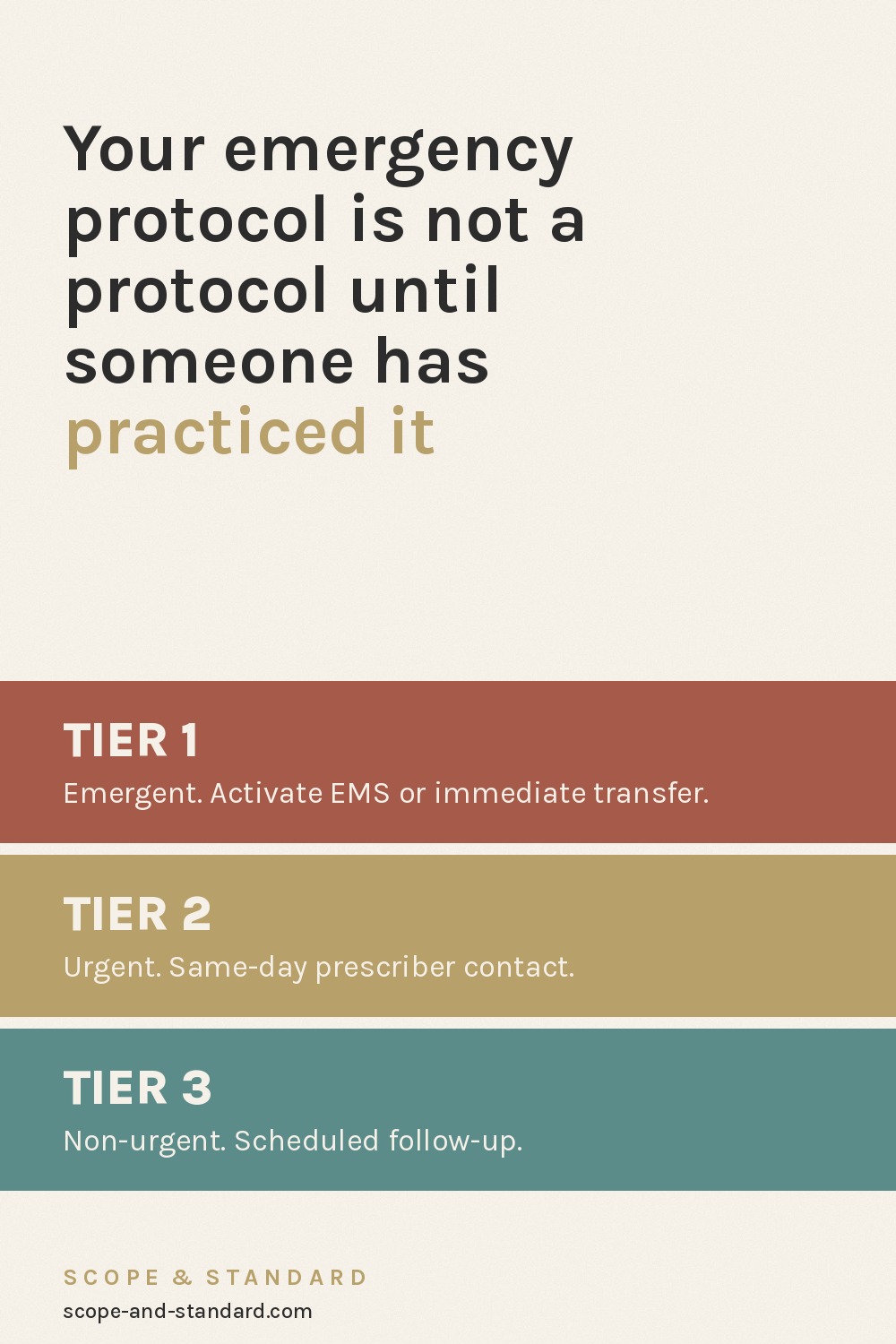
Your Emergency Protocol Is Not a Protocol Until Someone Has Drilled It
Published September 22, 2026 · 5 minute read
Every aesthetic practice that has been through a real event says the same thing afterward: the protocol was fine. The problem was that nobody had ever done it. The kit was in a cabinet somebody had to find the key for. The escalation tree listed a number that had changed. The person closest to the patient had read the page once, months earlier, at orientation.
A protocol that has never been practiced is a document. What turns it into a protocol is the drill, and what proves the drill happened is the log. Of the two, the log is the one almost nobody has.
What a drill looks like in a small practice
The word makes people picture a fire department. In a two-room med spa a drill is ten to twenty minutes and it needs three things: a scenario, a clock, and someone writing.
Pick one protocol page from the binder. Read the recognize block aloud as if it is happening. Then do the physical parts for real: someone retrieves the kit and opens it, someone reads the escalation tree and says who they would call and from which phone, someone finds the incident report form and starts filling the top of it. Stop the clock at the moment the first correct action would have been taken.
Then ask three questions. What took longer than it should have? What did we not know where to find? What was wrong on the page? Those answers are the point of the exercise. The protocol gets better because the drill found the gap before a patient did.
Why the log matters more than the drill
A drill without a log is a good afternoon. A drill with a log is evidence.
Evidence for three audiences. The first is your own team: the log is how a practice notices that the same step keeps breaking, that one room is consistently slower, that the new hire has never been through one. The second is an insurer or reviewer, who may ask when the practice last practiced its emergency response. "We do it regularly" is an answer that satisfies nobody. A dated row does. The third is the next staff member, who can read the last six drills and learn where the practice actually struggles rather than where the binder says it might.
The six fields a drill log needs
One row per drill. Six columns.
1. Date and time. The obvious one, and the one that makes every other field mean something.
2. Scenario. Which protocol page, by number, was drilled. Over a year the log should show every Tier 1 page at least once. A log that shows the same scenario twelve times is a log of a practice rehearsing what it is already good at.
3. Who was present. Names or initials. This is how the practice knows who has and has not been through a given scenario, and it is the field a competency sign-off sheet cross-references.
4. Time to first action. From the moment the scenario was called to the first correct step. Do not round it. A number that gets shorter over the year is the clearest evidence the drills are working.
5. What broke. The honest field. The kit was locked. The tree had an old number. Nobody knew where the incident form lived. If this field is blank on every row, the drill was not run hard enough.
6. What changed. The correction made because of this drill, and the date it was made. A moved kit, an updated tree, a page reworded. This field is what connects the log to the annual protocol review: the review should be able to read down this column and see the year's changes already listed.
Add a signature line for whoever ran it. Not the prescriber every time; whoever was in charge of that drill.
What the log is not
It is not a place to record clinical decisions. The drill practices the sequence on the page; it does not decide what goes in the blanks. The doses, thresholds, and escalation criteria on a protocol page are your accountable prescriber's decisions, written and signed by them, and a drill that reveals one of those blanks is still empty has found something worth writing down under "what broke."
It is also not a blame record. The log records what the system did, not who failed. A practice where people are reluctant to write "I could not find the kit" has a log that will always look better than the practice.
Where the log lives
In the binder, directly behind the protocol pages, and on the wall as a single sheet if the binder is not in the treatment area. A log that lives in a spreadsheet nobody opens gets updated after the fact, which is the same as not at all.
Pair it with two other documents: the staff competency sign-off, which records who has read and been walked through each protocol, and the post-event debrief form, which is the same six questions asked after a real event instead of a rehearsed one. The three together are the paper trail around an emergency system, and they are the part most protocol templates leave out.
The escalation tree is what a practice reaches for in the moment. The drill log is what it reaches for afterward, and it is the only one of the two that proves the first one works.
Questions this guide answers
How often should a med spa run an emergency drill?
The interval is your practice's decision and belongs in your own written protocol. What matters for the record is that the interval is written down, that every drill is logged with a date, and that a new staff member observes or runs one before their first unsupervised shift.
What should an emergency drill log record?
The date, the scenario or protocol drilled, who was present, time to first action, what broke, what changed as a result, and who signed off. Six fields, one row per drill.
Does a drill have to be a full simulation?
No. A ten-minute walkthrough where one person reads the protocol aloud and another physically retrieves the kit and reads the escalation tree counts, as long as it is logged and something is learned from it.