What Goes in a Med Spa Emergency Binder
Published September 21, 2026 · 4 minute read · General information, not legal advice. Your licensing regulators decide what applies to you.
Most aesthetic practices have an emergency plan. Ask to see it and you get a screenshot in a group chat, a laminated card from a weekend course, and a nurse who remembers most of it. That is not a binder. It is a memory.
An emergency binder is the set of documents a practice can put in front of an auditor, an insurer, a new hire, or a state board and say: this is what we do when something goes wrong, this is who decided it, this is when we last practiced it. Here is what goes in one, in the order it gets used.
1. The escalation tree
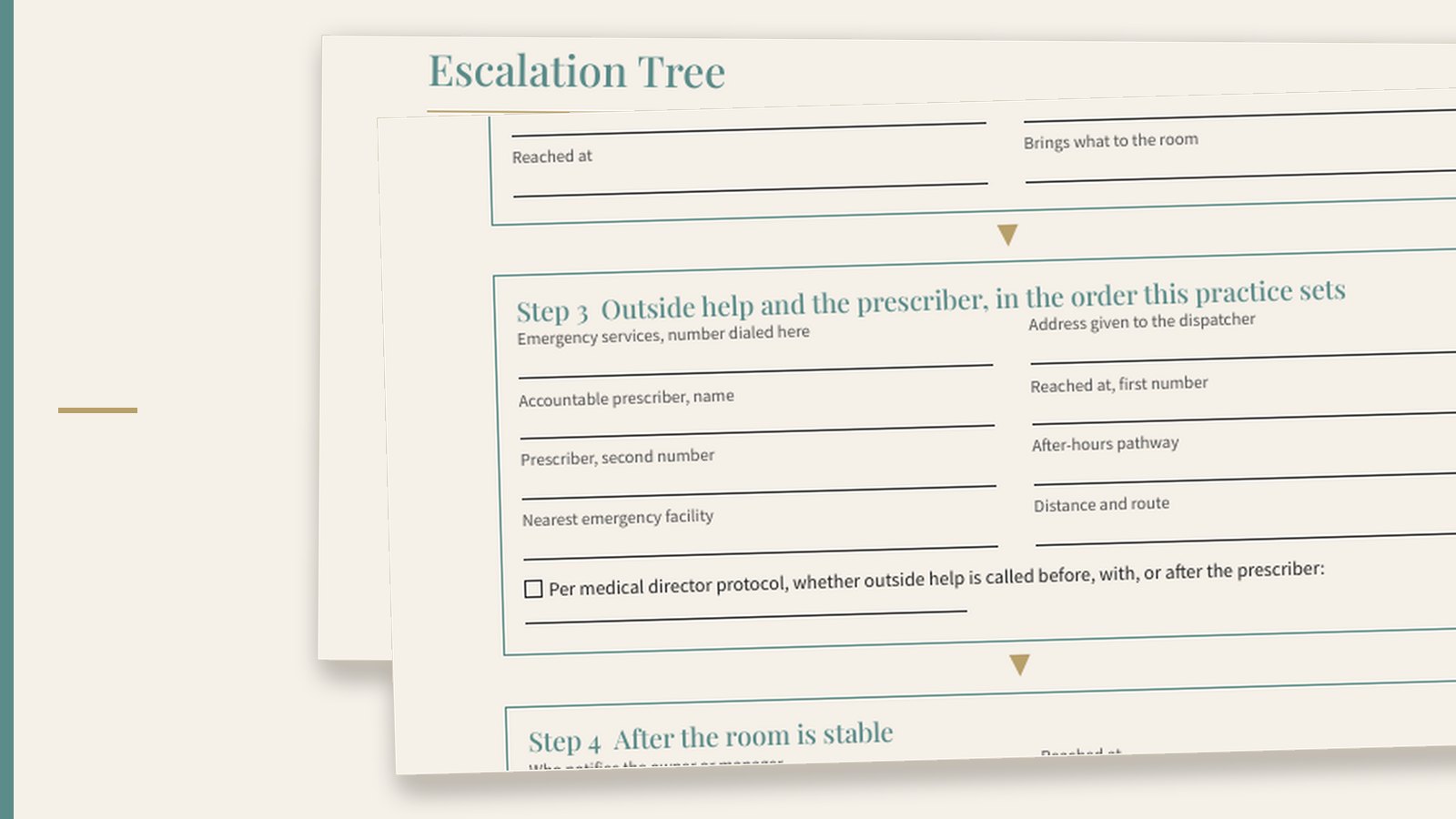
One page, on the wall, not in the binder. Who gets called first, at what number, and the criteria for calling EMS. It is the first thing a person reaches for and it should not require opening anything.
2. One protocol per complication, in one identical layout
Vascular compromise, severe allergic reaction, fainting, seizure, complications that appear days or weeks after treatment. Each one on a single page, each one in the same seven blocks: recognize, stop, immediate actions, escalate, do not, document, follow-up. The repetition is the point. Under stress nobody should have to learn a new page layout.
Get the free Drill Starter
A free print-and-fill file for running one emergency drill and keeping the record that shows it happened: a scenario card, a drill log and a debrief record. It comes by email with the Clinic Opening File, along with each new guide when it publishes.
Sent by Scope & Standard through beehiiv. Every email has an unsubscribe link. See Privacy.
3. Severity tiers, color coded
Emergent, urgent, non-urgent. A left-edge band on every protocol page. The person reading it should know within a second whether this is a call-EMS page or a call-the-prescriber-today page.

4. A DO NOT block on every protocol
A block the medical director completes with the actions to avoid for that complication. People under pressure make predictable mistakes, and a page that names them in advance, in the prescriber's words, is easier to follow than a memory. The framework supplies the block. The prescriber writes what goes in it.
5. Blanks where the clinical decisions belong
This is the part that surprises people. A binder written by someone outside your practice should not contain doses, drug selections, or thresholds. Those decisions belong to the prescriber who is accountable for your practice, in your jurisdiction. A good framework has a line that reads "per medical director protocol" followed by a blank, and your prescriber fills it and signs it. A binder with someone else's doses in it is a liability with a spine.
6. The medical director sign-off on every page
Not on the cover. On every page. It is what turns a downloaded template into an authorized practice protocol, and it is the first thing an auditor looks for.
7. The emergency kit contents checklist
With expiration dates and a monthly initial grid. Nothing prefilled, because your kit is your prescriber's decision. The grid is what proves somebody checked.
8. The drill log
A protocol nobody has run is a document. The drill log records the date, the scenario, who was there, time to first action, what went wrong, and what changed. Almost no practice has one. Every practice that has had a real event wishes it did.
9. The incident report form
One page. Times, product and lot, what was observed, who was called, disposition. With a field for the diluent or infusion fluid lot, not just the product lot, because a recall on the fluid is a real thing that happens.
10. The debrief form
What happened, what worked, what did not, what changes. Filled in within a week of any event or drill.
11. The annual review attestation
The date the whole binder was reviewed, what changed, the prescriber's signature, and the next review date. This is the page that makes the binder a living document rather than a one-time purchase.
The two most practices have: an escalation tree and a kit. The nine they are missing are the ones that matter in the room and the ones that matter afterward.
- Complication Protocol Bundle, 18 protocols, $89
- Complete Emergency Kit, $149
- Solo Injector Emergency Protocols, $59