What Goes in a Mobile IV Emergency Plan?
Published October 11, 2026 · 6 minute read · General information, not legal advice. Your licensing regulators decide what applies to you.
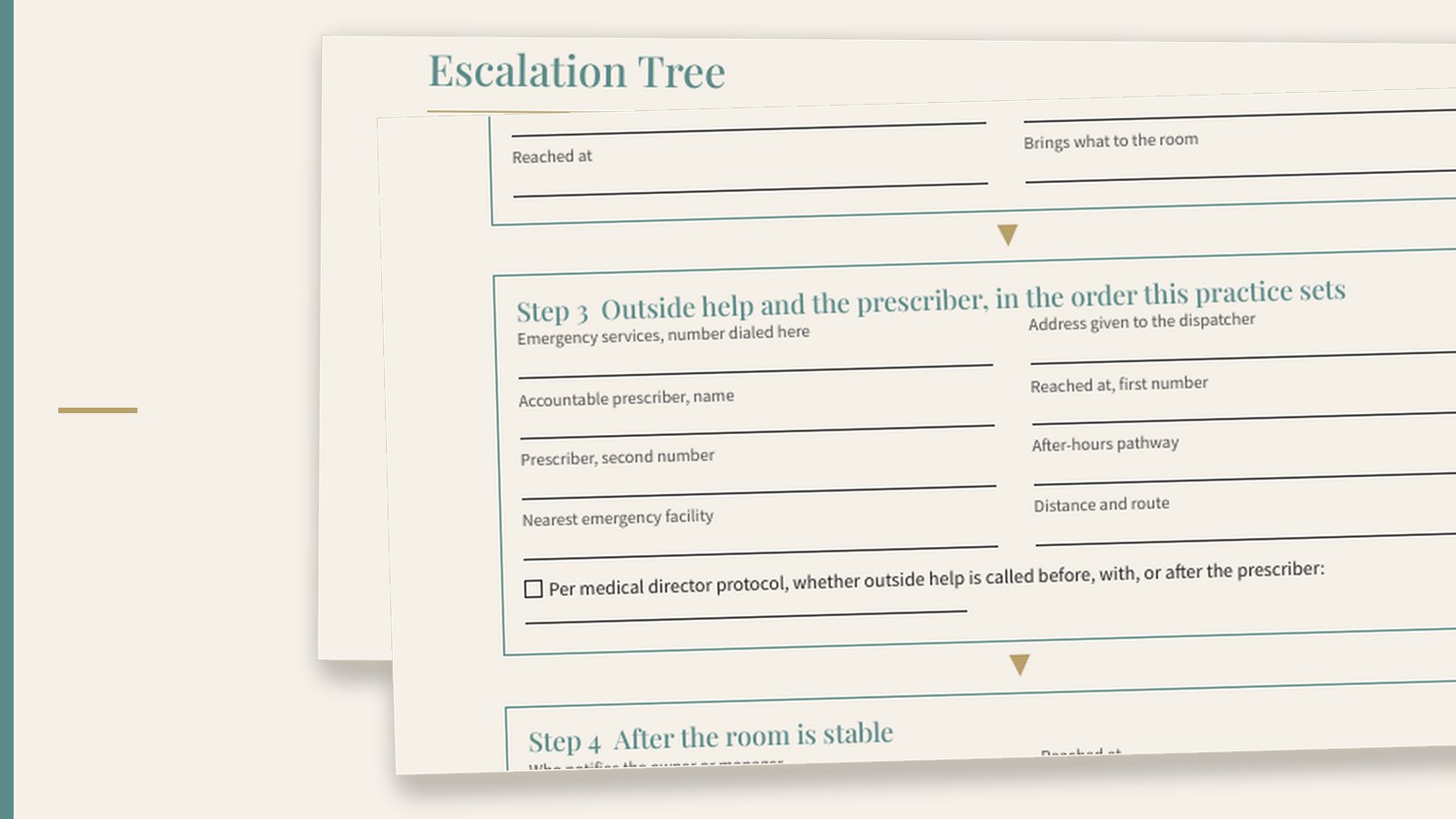
A mobile IV emergency plan answers the same questions a fixed-site plan answers. The difference is that half the answers are not the same twice, because the address, the way in, the way out and the nearest hospital change with every appointment.
So the plan splits in two: the half that is printed once and signed, and the half that stays blank until a dispatch sheet is filled in before the car leaves. Nothing below is legal advice or a clinical instruction. What goes in the clinical fields is the practice's own decision, made with its own clinician and its own counsel.
What the plan prints once
Four things hold still between visits: the escalation order and who sits at each step of it, the contents list for the kit, the roles named on the page, and the revision marker and review date the page carries. How to keep emergency escalation contacts current covers the first of those, which matters more off site, where nobody is standing at a desk to look up a number that rings out.
Everything else is a field.
The visit address is four fields, not one
A street address gets an ambulance to the curb. It does not get anyone to the patient.
The dispatch sheet carries the address as the patient confirmed it, the unit or suite and floor, the entry detail (gate code, callbox name, which door is open at that hour), and where the vehicle is parked relative to that door. The parking line is there for the return trip with a bag, not for the drive in.
One more field belongs beside them: whether anyone else is at the address who could open a door for arriving help.
Get the free Drill Starter
A free print-and-fill file for running one emergency drill and keeping the record that shows it happened: a scenario card, a drill log and a debrief record. It comes by email with the Clinic Opening File, along with each new guide when it publishes.
Sent by Scope & Standard through beehiiv. Every email has an unsubscribe link. See Privacy.
Nearest facility, recorded in travel time
The plan names this field and leaves the answer to the sheet. The entry holds the facility, the route and the travel time at the hour of the appointment.
A route that runs clear at 2 pm on a Tuesday is a different route at 6 pm on a Friday, and the appointment is booked at an hour rather than at a mileage.
Federal workplace rules make the same measurement matter for a different reason. 29 CFR 1910.151(b) opens "In the absence of an infirmary, clinic, or hospital in near proximity to the workplace" and continues "which is used for the treatment of all injured employees," before requiring that "a person or persons shall be adequately trained to render first aid." It closes with "Adequate first aid supplies shall be readily available." That provision is about employees rather than patients, and it is cited for one point: proximity is what the rule turns on, and proximity has a new answer at every address.

The check-in for a clinician working alone
A fixed site has people in it. A mobile visit has one clinician at a stranger's address, and the plan's job is to make an unanswered phone a trigger rather than a worry.
The fields are plain: departure time, a confirmation when the clinician arrives, the expected finish, the role holding those confirmations, and what that role does when one does not arrive and by when. Name the role rather than the person, so a staffing change does not strand the page.
Where the kit rides
In a clinic the kit's location is a room and a shelf. In a vehicle it is whatever bag somebody packed. The emergency kit location record sets out the fields, and the mobile version identifies the vehicle, names the place inside it, and carries a pre-departure check with the initials of whoever did it.
The retrieval time field is worth adding to the mobile drill, because off site that number counts the stairs and the front door.
A published plan structure worth borrowing
OSHA's emergency action plan standard, 29 CFR 1910.38, is written for workplaces rather than for clinical services, and its paragraph (a) applies the section to each plan that another standard in that part requires. Whether any of it reaches a given practice is a question for that practice's own counsel and its carrier. It is cited here for the shape of the document.
Paragraph (c) sets six minimum elements. Five read verbatim as "Procedures for reporting a fire or other emergency;", "Procedures for emergency evacuation, including type of evacuation and exit route assignments;", "Procedures to be followed by employees who remain to operate critical plant operations before they evacuate;", "Procedures to account for all employees after evacuation;" and "Procedures to be followed by employees performing rescue or medical duties;". The sixth names the employee other employees can contact for more information about the plan or an explanation of their duties under it.
Read that list against a mobile service and two items stand out. Exit route assignments cannot be printed, because the exit is at an address the practice has not seen. Accounting for everyone after an evacuation is the same problem, which is why the check-in line above exists.
Paragraph (b) is the one small practices tend to find surprising. The text reads "An emergency action plan must be in writing, kept in the workplace, and available to employees for review." Then: "However, an employer with 10 or fewer employees may communicate the plan orally to employees." A spoken plan cannot be produced for an insurer, and it cannot be handed to a clinician driving to an address alone, which is the argument for writing it down whatever the headcount.
Review, and what triggers it
Paragraph (f) of the same section gives three review triggers worth borrowing: when the plan is developed or the employee is assigned initially to a job, when the employee's responsibilities under the plan change, and when the plan is changed.
A mobile service adds a fourth that a fixed site never meets. A new service area means new routes and new receiving facilities, so the page moves its revision number when the map changes. Version control for emergency protocol pages covers the numbering, and the emergency binder is where the printed half lives.
The visit's own record is separate from all of this. IV therapy documentation covers what the infusion record holds, and what a mobile IV therapy SOP must contain covers dispatch and closeout for the ordinary visit.
What the paid frameworks hold
The Emergency Preparedness Module carries the preparedness pages and the drill records. The Emergency Documentation Set holds the records that run after an event. The IV and Infusion Treatment Record is the visit's own chart. The clinical fields in all three are blank, and what goes in them is the practice's decision to make and to sign.
Do this next
Take the next mobile visit on the schedule and fill in four lines before departure: the confirmed address with its entry detail, the receiving facility with travel time at that hour, the role holding the check-in and the time it is due, and where in the vehicle the kit is. The line nobody can fill in from what is already on file is the first page of the plan to write.
- Emergency Preparedness Module, $29
- Emergency Documentation Set, $29
- IV and Infusion Treatment Record, $8
Questions this guide answers
What does a mobile IV emergency plan include that a fixed-site plan does not?
Per-visit fields. A fixed site prints its address, its exits and its nearest facility once, because none of them move. A mobile service answers those four things again at every appointment, which means they belong on the dispatch sheet rather than on the wall page.
Who holds the check-in when a clinician works alone?
A named role rather than a name, so the page survives a staffing change. The plan records which role holds the check-in during a visit, the time the clinician is expected to confirm arrival and finish, and what that role does when the confirmation does not arrive.
Does the plan say which hospital to use?
It names the field, not the answer. The nearest facility is a per-visit entry, recorded with the route and the travel time at the hour of that appointment, because the answer at 2 pm on a Tuesday and at 6 pm on a Friday are not the same answer.
Where does the emergency kit's location get recorded for a mobile visit?
On the kit location record, with the vehicle identified and the place inside it named, plus the pre-departure check and the initials of whoever did it. A kit that rides in a different bag each day cannot be found by anyone who did not pack it.
How often does the plan get reviewed?
On a dated schedule the practice sets, and on events. A new service area, a change to the escalation list and a change in who holds the check-in are all reasons to revise the page and move its revision number, independently of the calendar.