Before You Hire Your Second Nurse: The Onboarding File
Published September 22, 2026 · 5 minute read
A single-provider practice runs on one person's memory. Where the kit is, which protocol applies, how the prescriber likes to be reached, what to do when the portable cooler alarm goes off. None of it is written down because there has never been anyone to write it down for.
The second clinical hire ends that. Not because the new person is less capable, but because the practice now has to prove that what it knows was transferred, and that the person doing the transferring had the authority to. That proof is the onboarding file. Here is what goes in one, and which page to write first.
Write the emergency orientation first
Before the role description, before the license log, write the one-page emergency orientation sign-off. It is the shortest document in the file and the one with the worst consequences if it is missing.
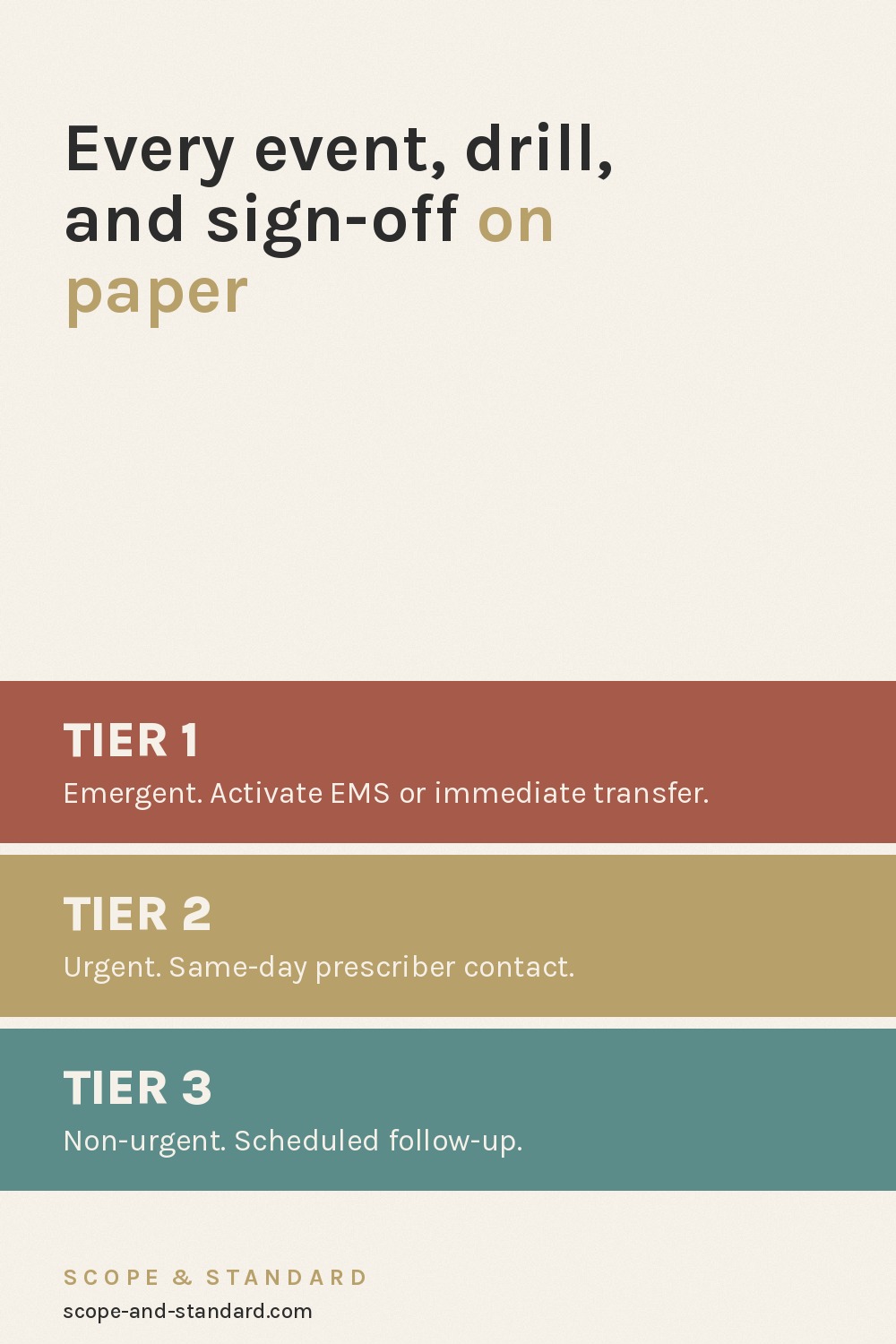
It lists the things a new clinical or front-desk hire must be shown before their first unsupervised shift: where the emergency binder is, the escalation tree walked through with the EMS address rehearsed aloud, the kit and AED locations, which protocols they have read, which role they hold in a Tier 1 event (who calls, who stays with the patient, who documents), and that they have observed at least one drill. Each line gets a date and initials. The bottom gets three signatures: the new hire, the orientation lead, and the prescriber's acknowledgment.
A practice can survive a slow onboarding on everything else. It cannot survive a new hire alone in a treatment room who does not know where the kit is.
The eight documents
1. Role description. What this role does, what it does not do, and under whose authority. Written as a framework with blanks, because the scope of any clinical role is a jurisdictional question the practice verifies with its own board, not something a template can assert. The description should reference the practice's supervision page rather than restate it.
2. License and certification verification log. For each credential: type, number, issuing authority, date verified, verified by, expiration, and a renewal reminder date. One row per credential per person. This is the page that catches a lapsed certification before a payer or reviewer does.
3. Orientation checklist. The operational walk-through: systems, scheduling, charting, product storage and temperature logging, cleaning schedules, how supplies are ordered, how the day opens and closes. Every line dated and initialed. It is separate from the emergency orientation on purpose; the emergency page should not be buried on page three of a forty-line list.
4. Protocol acknowledgment sheet. A list of every written protocol in the practice, and for each, the date the new hire read it and the date they were walked through it by someone who already knew it. Reading is not the same as being walked through. Both columns matter.
5. Competency validation record. Skill by skill: observed by whom, on what date, validated or not yet. Filled by the validator, never self-reported. The list of skills is the practice's own, signed off by the accountable prescriber, and it includes the non-clinical ones that cause incidents: reconstitution labeling, cooler handling, lot recording, chart completion.
6. Supervision and coverage page. How supervision works for this role in this practice: who supervises, how they are reached during treatment hours, what happens when they are unavailable, and which activities require the supervisor present. Every line is blank in a framework because every line is a jurisdictional decision. The document is the practice's record that the decision was made and by whom.
7. Annual revalidation schedule. Which competencies are revalidated, how often, and when this person's next date is. Without this page, the competency record is a snapshot from the first month that nobody looks at again.
8. Personnel file contents checklist. The single sheet on the front of the folder listing what should be inside: the seven documents above, the signed emergency orientation, copies of credentials, and anything the practice's own policy requires. A reviewer who opens the folder should be able to check the sheet against the contents in a minute.
The mistake the second hire exposes
The first hire usually reveals that the practice's protocols were never fully written down, and the owner spends a weekend writing them. That is the right instinct and the wrong sequence. The protocols should exist before the job is posted, because the onboarding file references them on nearly every page. Protocol acknowledgment needs protocols to acknowledge. Competency validation needs a standard to validate against. The emergency orientation needs a binder to point at.
So the practical order is: protocols and emergency binder first, signed by the prescriber. Then the onboarding file, which is mostly a set of tables that reference them. Then the job posting.
What none of this decides
The onboarding file does not decide what a role is permitted to do, how supervision must work, or what training a credential requires. Those are questions for the practice's licensing boards and its accountable prescriber, and the file's job is to record that they were asked, who answered, and when. A framework that arrives with those blanks already filled in has answered a question it had no standing to answer.
The second nurse is not the risk. The risk is the six months between the first and the second, when everything the practice knew lived in one person and nobody noticed.
Questions this guide answers
What should be in a med spa onboarding checklist?
A role description, a license and certification verification log, an orientation checklist, a protocol acknowledgment sheet, a competency validation record, a supervision and coverage page, a personnel file checklist, and an emergency orientation sign-off completed before the first unsupervised shift.
What is a nurse competency checklist in an aesthetic practice?
A record, per skill, of who observed the new staff member perform it, on what date, and whether it was validated. It is filled by the validator, not the new hire, and revalidated on a schedule the practice sets.
Who writes the onboarding file if the practice has one owner and no HR?
The owner, using frameworks with blanks. The structure is the same for every practice; the role definitions, supervision arrangement, and competency list are the practice's own and are signed off by the accountable prescriber.