How to Open a Med Spa as a Nurse: The Two Questions Before the Menu
Published October 10, 2026 · 6 minute read · General information, not legal advice. Your licensing regulators decide what applies to you.
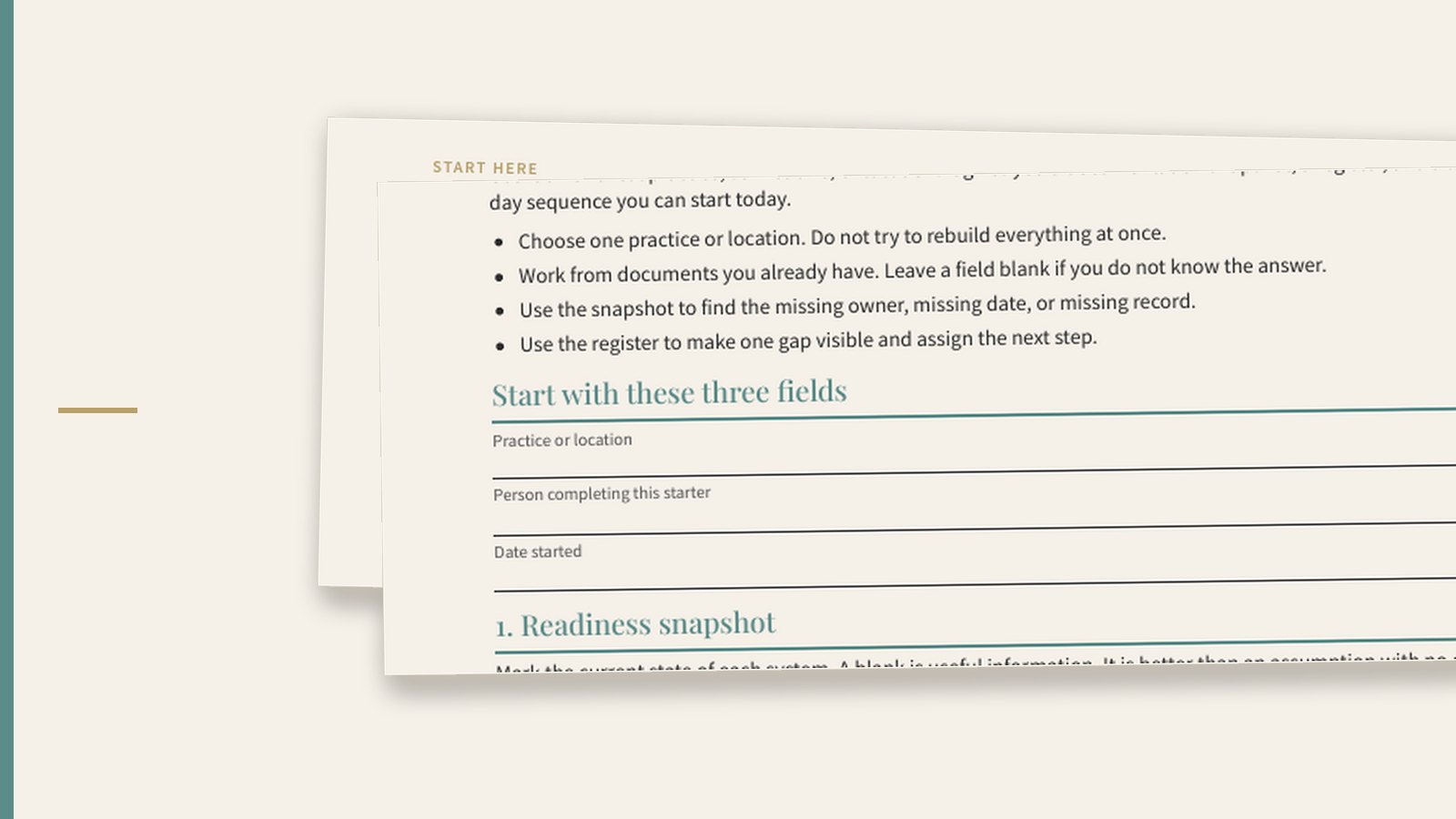
How to open a med spa as a nurse is really two questions, and different authorities answer them. The first is whether someone holding a nursing license may own the business at all. The second is which services on the planned menu that license may perform, and under whose authority the rest get performed.
Neither answer comes from a template and neither is the same everywhere. What follows is where each one comes from and what record it leaves. It is not legal advice, and every step routes to a verification done with the practice's own boards and its own counsel.
Question one: who may own the practice
This one gets asked before the entity, the lease and the menu, because an answer arriving after any of those can undo all three.
The question that matters is whether a business offering medical services may be owned by someone who is not licensed to provide those services. That sits with the state's own law and with the boards that administer it. The answer can turn on the form of the entity rather than on the owner's license, and it can turn on which services the menu carries. How to verify what your state requires covers which body to ask and how to phrase a question so the answer is usable months later.
What comes back is worth writing down in full: the body that answered, the question as it was asked, the answer in its own words, the date, and the name of the person who asked. Recording an authority response sets out the fields. An answer held in memory from a phone call cannot be produced for an insurer, a landlord or anyone performing due diligence on the practice later.
Question two: under whose authority each service gets performed
The unit here is the service, not the business. A menu line reading "injectables" cannot be answered, because it names a category rather than an activity.
Each line gets its own set of answers: who may perform it, what has to happen before anyone does, which authority permits that, and what oversight applies while it happens. The four answers are not always given by the same body, and they do not always come back the same way for two services that look adjacent on a price list. Delegation, supervision and standing orders separates the three arrangements those answers tend to use, and the blank scope and delegation matrix is the grid the answers get written into, one activity per row.
Get the Clinic Opening File
A free print-and-fill file for owners getting ready to open: a workstream index, an open items register, a document inventory and an opening day go or no-go record. It comes by email, along with each new guide when it publishes.
Sent by Scope & Standard through beehiiv. Every email has an unsubscribe link. See Privacy.
A published framework for the scope half
The National Council of State Boards of Nursing publishes a Scope of Practice Decision-Making Framework, a tool for working out whether a nurse may take on a given activity, given what their education and licensure cover and what competence they can show, within the rules of the nurse practice act where the license is held (NCSBN).
Its first step is the one most useful to someone drawing up a menu: "Identify, describe or clarify the activity, intervention or role under consideration." The activity gets described before anyone asks who may do it. A service named at the level of a price list is not yet described well enough for the question to have an answer, which is why the matrix above works one activity per row rather than one service line per row.
The page carrying the framework states that the guidelines are for educational purposes and do not establish a standard of care. That is the right way to read it here, as a source on how the question is structured rather than as a rule that reaches the reader.
The license category is not one category
A separate publication from the same council is useful for a different reason. The 2008 Consensus Model for APRN Regulation builds its definitions around four advanced practice roles, each tied to a population focus, and treats that licensure as distinct from other nursing licensure (NCSBN, PDF). For a planned menu, that matters because the authority to evaluate a patient and to authorize a treatment may sit with one category and not another, and the two halves of question two can land on two different people.
The same document states that "The services or care provided by APRNs is not defined or limited by setting but rather by patient care needs." Written for the advanced practice roles, the sentence still carries a point worth holding onto while a clinic is being planned: a storefront does not widen what a license covers, and it does not narrow it either. Whether any part of the model has been taken up where the reader is licensed is a question for that reader's own boards. It is cited here for how the categories divide, not as a rule in force.
Where a prescriber arrangement starts
If the verified answers put part of the menu outside what the owner's license covers on its own, the practice needs an accountable prescriber, and that is a separate decision with its own document and its own set of blanks. Do I need a medical director works through it service by service. One trap sits close to this point for a nurse-owned practice with devices on the menu: a prescriber engaged for one part of the service list does not thereby cover the rest, which telehealth prescriber does not cover your devices takes apart.
The sequence these two questions sit at the front of is in how to open a med spa, which runs from verification through the first drill.
What the paid frameworks hold
The Clinic Opening Kit holds the opening decision records, including the service menu decision log and the verification trail the answers above get written into. The Staffing and Competency Module carries the scope and delegation matrix along with the competency validation record for each activity on it. The Medical Director Oversight Module holds the logs that run after a prescriber arrangement exists. The clinical fields in all three are blank, and what goes in them is the practice's decision to make and to sign.
Do this next
Write the planned menu out, one service per line, then split any line that names a category rather than an activity. Beside each line leave four blanks: who may perform it, what has to happen before anyone does, which body answered that, and the date of the answer. The lines still carrying blanks are the ones to take to a verification call before the entity gets formed.
- Clinic Opening Kit, six frameworks, $149
- Staffing and Competency Module, $29
- Medical Director Oversight Module, $34
Questions this guide answers
Can a nurse own a med spa?
Whether someone holding a nursing license may own a business offering medical services is answered by the state's own law and by the boards that administer it, not by the entity type chosen first. The answer can turn on the form of the entity and on what the menu includes, so the question gets asked before the lease and the answer gets recorded with its date and the name of the body that gave it.
What has to be settled before the lease?
Who may own the practice, which services on the planned menu the owner's license may perform, under whose authority the rest get performed, and where each of those answers came from. A menu drawn up before those answers exist is a menu that may have to change.
Does opening in a med spa change what a nursing license covers?
The question is answered by the license and by the nurse practice act where it is held rather than by the type of business. The Consensus Model for APRN Regulation makes the same point for the advanced practice roles: services are not defined or limited by setting but rather by patient care needs.
Is a nurse the same as a prescriber for this purpose?
Not necessarily. The advanced practice roles are defined separately from other nursing licensure, so the authority to evaluate a patient and to authorize a treatment may sit with one category and not another. Which services a given license may authorize rather than perform is a question for the practice's own boards and its own counsel.
What record should the ownership answer leave?
The body that answered, the question in the words it was asked, the answer in the words it came back in, the date, and the name of the person who asked. An answer remembered from a phone call cannot be produced later, and the question gets asked again when the menu changes.