How to Open a Med Spa: The Document Sequence Nobody Gives You
Published September 21, 2026 · 4 minute read · General information, not legal advice. Your licensing regulators decide what applies to you.
Search "how to open a med spa" and you get business plans, financing, and buildout. Nobody hands you the document sequence, which is odd, because the documents are what an inspector, an insurer, and your first hire will actually ask to see. Here is the order the paperwork needs to happen in, and why the order matters.
This is a sequence, not a license application guide and not legal advice. Every step routes to a verification you do yourself, in your own jurisdiction, with your own accountable prescriber.
Phase 1: before anything, weeks 1 to 4
Verify the jurisdiction first. Before the entity, before the lease. Who may perform each procedure on your planned menu, under whose authority, with what supervision. Whether a prescriber evaluation is required before treatment. Whether standing orders are permitted or every order has to be patient-specific. Ownership rules that decide who is allowed to own the practice at all. These answers come from your state's board of nursing, board of medicine, and board of pharmacy, and they are the answers everything else is built on. A one-page verification sheet that names which board answers which question is free here.
Scope of practice reality check. Can your license do the menu at this location, per what you just verified. If the answer changes the menu, better now than after the lease.
The accountable prescriber relationship. Whatever your jurisdiction calls that role, identify the person, agree in writing, and record what the oversight has to look like. Nothing clinical gets written down before this person exists.
Entity, insurance, structure. Your accountant and your attorney. A good sequence names these steps and leaves them blank.
Decisions to record: the service menu draft, the target jurisdiction confirmed, the budget envelope.
Phase 2: the shell, weeks 5 to 8
Fixed site, mobile-first, or both. Decided against what the verification said about each setting, not against what looks appealing.
Governance written down. Who the accountable prescriber is, what they oversee, how orders are authorized, what the supervision level is by service. This is Section 1 of any operations manual and it is the section that makes every other section defensible.
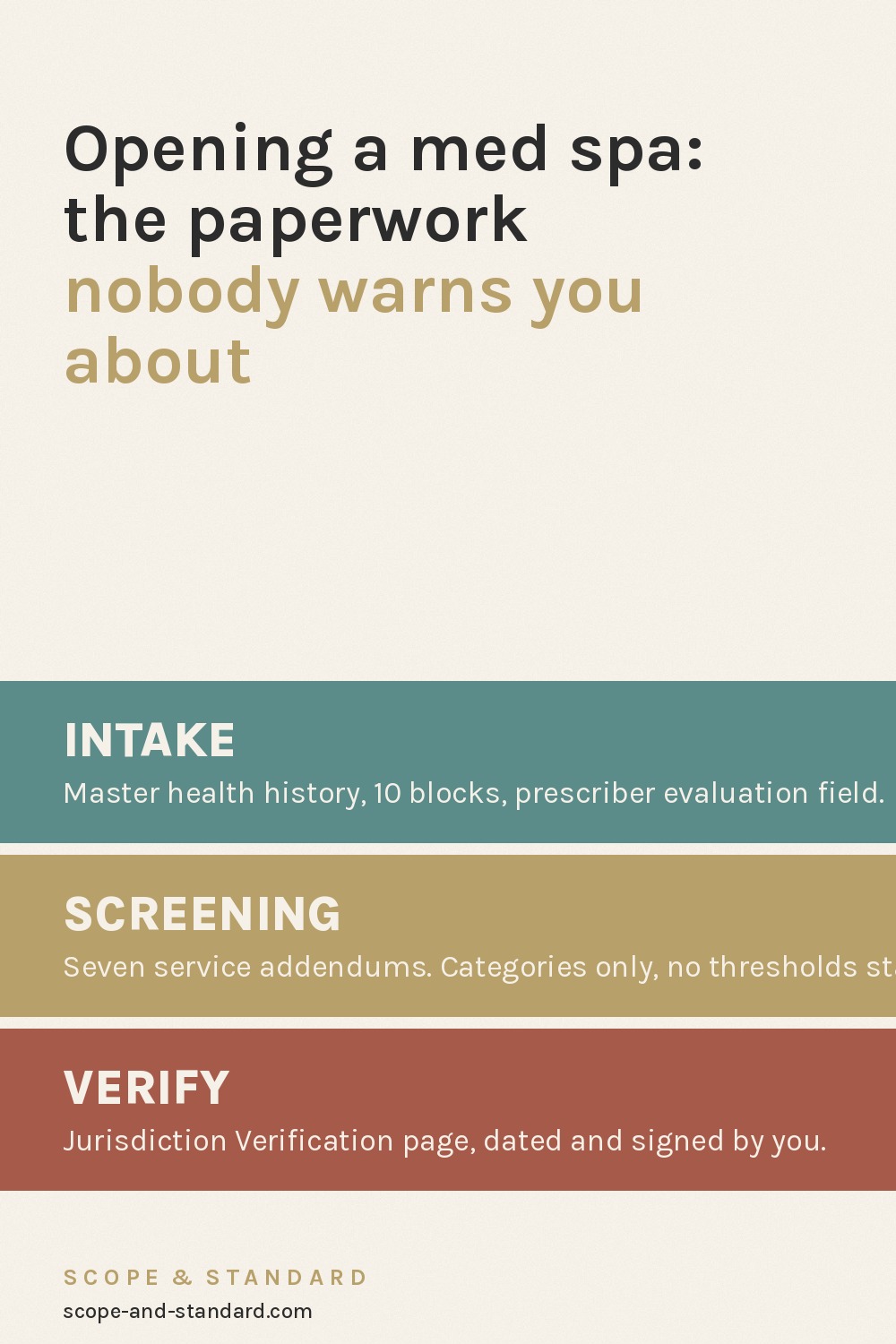
Intake and screening built for the actual menu. One master health history and one screening addendum per service line, because IV hydration, injectables, and peels screen for different things. Every threshold blank for the prescriber. The prescriber evaluation field on the form, because many jurisdictions require it before delegated treatment.
Product sourcing documented. Where product comes from, what paperwork you keep on file, how lots are tracked. Not regulatory advice, record-keeping fields.
Decisions to record: hours model, pricing philosophy, which record system you will chart in.
Get the Clinic Opening File
A free print-and-fill file for owners getting ready to open: a workstream index, an open items register, a document inventory and an opening day go or no-go record. It comes by email, along with each new guide when it publishes.
Sent by Scope & Standard through beehiiv. Every email has an unsubscribe link. See Privacy.
Phase 3: the systems, weeks 9 to 12
The emergency layer. One protocol per complication, same layout on every page, tier-coded, DO NOT block on each, every pharmacologic step a blank your prescriber fills and signs. Then the first drill, scheduled and run before the first patient. What goes in a med spa emergency binder walks through the eleven documents.
The charting layer. Treatment records per encounter with product and lot fields, and a software field-mapping pass before anyone configures the practice software, so the paper form and the screen agree.
Staffing. Role descriptions, license verification, competency validation, protocol acknowledgment. Even if the only staff member is you, the personnel file is a record an inspector or insurer may ask to see.
The review calendar. Annual protocol review date, verification re-check date, drill schedule. Written down once so it happens.
Decisions to record: go or no-go fields, launch date, first-30-days targets.

Phase 4: open, week 13 and beyond
The first 30 days. First drill logged. First chart audit. First intake cycle reviewed for what the form missed.
The 90-day retrospective. What the sequence got wrong for this practice, written down, because the second location or the next hire will need it.
The standing cadence. What gets re-verified, when, by whom.
Why the order matters
Most practices do this backwards: lease, buildout, then discover the menu they planned needs a supervision level they cannot provide, or that the setting they chose is not permitted for their practice type. The paperwork is cheap to do first and expensive to redo.
Every row above has one of three sources: a document your practice completes, a verification authority that answers the question, or an adviser. A sequence that tells you the answer instead of where to get it is guessing at fifty states' rules.
- Clinic Opening Kit, six frameworks, $149
- Intake and Screening Module, $29
- Complication Protocol Bundle, 18 protocols, $89